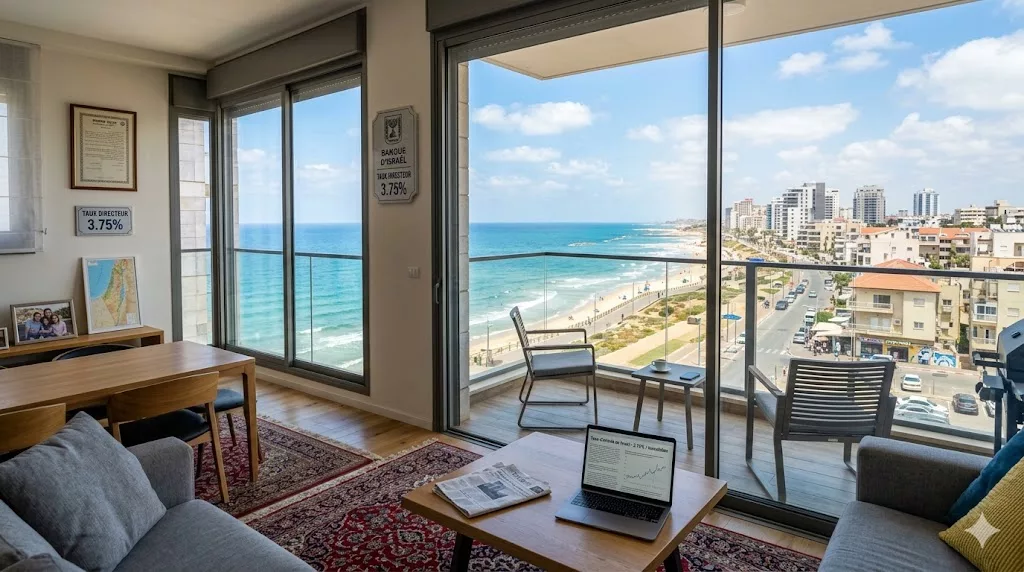
On May 26, 2026, the Bank of Israel lowered its key rate to 3.75%. It's the second cut of the year, after the one on January 5th. Headlines surged in the Israeli economic press: "good news for buyers". But for whom exactly? For an American whose dollar has lost 13.6% against the shekel in a few months, the equation is very different from that of a French person, whose euro has only declined by 4%. And radically different from that of a local buyer in shekels. Here's the real calculation, backed by official figures.
A downward cycle taking hold, not a stroke of luck
To understand what this decision really means, it must be placed in its trajectory. The Israeli key rate reached a peak of 4.75% at the height of the fight against inflation. Since then, the Bank of Israel has conducted a methodical descent: 4.5%, 4.25%, then 4% on January 5, 2026, and now 3.75%. Cumulatively, that's a full percentage point recovered in less than a year.
The official statement from the Bank of Israel cites three factors that enabled this decision: inflation brought down to 1.9% annually (within the central bank's target), the appreciation of the shekel which mechanically reduces imported inflationary pressures, and a gradual return to normal economic activity after Operation "Lion's Roar". The Bank of Israel's research department anticipates at least two more cuts by the end of 2026, which would bring the rate to 3.25-3.5% in December.
This is no longer a cyclical anomaly. It's an established easing cycle, and it's reshaping the market.
What this concretely changes for the mashkanta
The Israeli Association of Mortgage Advisors published the exact calculation on the day of the decision: on a loan of 1,000,000 NIS over 25 years, with 450,000 NIS in prime track (indexed to the key rate), the 0.25% decrease represents a saving of 67 NIS per month and 20,000 NIS over the total loan duration.
It's little in absolute value. But when combined with previous cuts, the cumulative effect since the peak of 4.75% represents a monthly saving of around 270 NIS on the same prime portion — or more than 80,000 NIS over the life of the loan. For a loan of 2 million NIS (~556,000 USD), the gain becomes very significant.
The association nevertheless reminded of a reality that banks don't spontaneously communicate: "even after this cut, the monthly repayment level remains well above what it was before the rate hike cycle, while average apartment prices have continued to rise". The relief is real. The complete solution is not yet there.
The strong shekel trap: when rate cuts are not enough
This is where the analysis diverges according to community of origin. The same Bank of Israel statement that announces the rate cut also notes that "the shekel has appreciated 8.3% against the dollar and 7.2% against the euro since the last rate decision". Cumulatively over a year, the dollar's fall against the shekel exceeds 13.6%.
Concrete translation for an American buyer: an apartment in Netanya listed at 2,000,000 NIS cost ~480,000 USD a year ago. Today, despite the rate cut, the same property costs ~556,000 USD — or 80,000 dollars more, solely due to the exchange rate. The 0.25% cut on the mashkanta doesn't compensate for this 16% loss of purchasing power in dollars.
This phenomenon is directly reflected in official data. The Ministry of Finance has just published for the first time a detailed analysis of foreign purchases in Israel: in Q1 2026, Americans represent 49% of foreign buyers (238 apartments), a notable decline from 60% and 248 apartments in Q1 2025. The correlation with the weakening dollar is explicitly mentioned in the report.
Conversely, French buyers — whose euro has only given up 4% against the shekel — have increased their purchases by 55% in one year : 130 apartments in Q1 2026 versus 84 in Q1 2025. They now represent 26.7% of all foreign purchases. The British have also progressed, going from 37 to 57 transactions over the same period.
Who buys what and where: the community map in 2026
Ministry of Finance data also reveals very different purchase geographies according to communities — valuable insight for any diaspora buyer considering their project.
Americans are massively concentrated in Jerusalem: 52.5% of their Q1 purchases, or 125 apartments. The median price of an American purchase in the capital reaches 5.1 million NIS (~1.42M USD) for the overall market, and 5.95 million NIS for new properties. This is the high-end and symbolic segment. Netanya comes second (27 transactions), ahead of Beit Shemesh (24).
French buyers have a broader distribution and more accessible budgets: Netanya leads (35 transactions), followed by Jerusalem and Tel Aviv tied (28 each). Bat Yam appears on the map for the first time. The average price of a French purchase stands at 2.8 million NIS (~778,000 USD) — significantly lower than American levels, with a median in Tel Aviv of 5 million NIS versus much more for Americans in the same city.
To put these figures in perspective with CBS data: the national average price of an apartment in Israel in Q1 2026 is 2.33 million NIS (~648,000 USD). Tel Aviv shows an average of 4.59 million NIS (~1.28M USD), Herzliya 3.85 million, Jerusalem 3.1 million. At the bottom of the table: Beer Sheva at 1.24 million NIS (~344,000 USD), Ashkelon at 1.64 million, Haifa at 1.8 million.
Should you buy now, or wait for the rest of the cycle?
The question is legitimate. Here are the objective elements for deciding.
For a buyer in shekels or euros: the downward cycle is established, prices still show -1.2% year-on-year across the entire market according to CBS, and some cities offer interesting windows. Haifa (+6.9% over a year) and Netanya (+8.2%) are progressing, but remain well below Tel Aviv levels. Beer Sheva and the south are accessible. Waiting longer risks seeing prices rebound as rates fall and demand returns.
For a buyer in dollars: the timing question is more delicate. If you think the dollar will restabilize against the shekel, the market indeed offers an opportunity — prices in NIS are moderate and the rate trend is favorable. If you think the current dynamic continues, each month of delay costs in purchasing power what the rate cut gives you back.
In both cases, the supply of unsold new housing exceeds 86,000 units — a record level — which gives serious buyers real negotiating power, particularly with developers.
To navigate this environment and understand all the steps of buying in Israel, consult our Ultimate Guide to Real Estate in Israel — from search to signing, including taxation and financing.
In summary
The rate cut to 3.75% is a positive signal, but it's not uniform information. It lightens the mashkanta for local borrowers and buyers whose currency holds against the shekel. However, it doesn't compensate for the loss of purchasing power of communities whose currency has depreciated significantly. The map of foreign buyers in Israel is reorganizing in real time — and it says something essential: the purchase project in Israel depends as much on the exchange rate as on the interest rate.