Whether you're arriving in Israel for the first time, preparing your aliyah, or looking for temporary housing before buying, renting is often the first step. And this is where the culture shock begins: no regulated lease, post-dated checks for 12 months, guarantees that may seem disproportionate, and a contract written in Hebrew that no one translates for you.
This guide explains how renting works in Israel, what's normal, what's negotiable, and what should alert you.
📖 This article is part of theUltimate Real Estate Guide for Israel
The Israeli rental market: what you need to know
The rental market in Israel istight. Demand exceeds supply in major cities, rents are not regulated by the state, and there is no law governing rent increases between leases. The balance of power is often in favor of the landlord, especially in sought-after areas.
Leases are usually12 months, renewable by mutual agreement. Some landlords offer 2-year leases with an early exit option. Leases of 3 years or more are rare in residential.
The housing search goes through real estate agencies, online portals (including immobilier.co.il), community Facebook groups, and word-of-mouth — particularly effective in Francophone communities.
See rental properties on immobilier.co.il →
The rental contract (Hozeh Skhirout)
No standard contract
Unlike France where the lease is largely regulated by law, in Israel there isno standard rental contract. Each landlord (or their lawyer) writes their own, with their own clauses. Everything is negotiable — and everything must be read carefully.
The contract is written inHebrew. If you don't master the language, ask a lawyer or trusted person to translate and explain each clause before signing. Never sign a document you don't fully understand.
⚠️ Critical point: Some contracts contain abusive clauses that transfer to the tenant responsibilities normally borne by the landlord (structural repairs, replacement of obsolete equipment). Read everything. Negotiate. Refuse what is not fair.
What the contract must contain
A good rental contract specifies at minimum: the identity of the parties, description of the property (address, floor, number of rooms, annexes), the rent amount and payment terms, lease duration, renewal conditions, amount and nature of guarantees, distribution of charges, termination conditions, and the entry inventory.
Conducting an inventory
The inventory is not a legal obligation in Israel — but it's an essential precaution. Document the condition of the property upon entry withdated photos of each room, each visible defect, and send them to the landlord by email to keep a record. Do the same when leaving. It's your protection in case of disputes over the deposit.
Rent: payment and post-dated checks
The check system
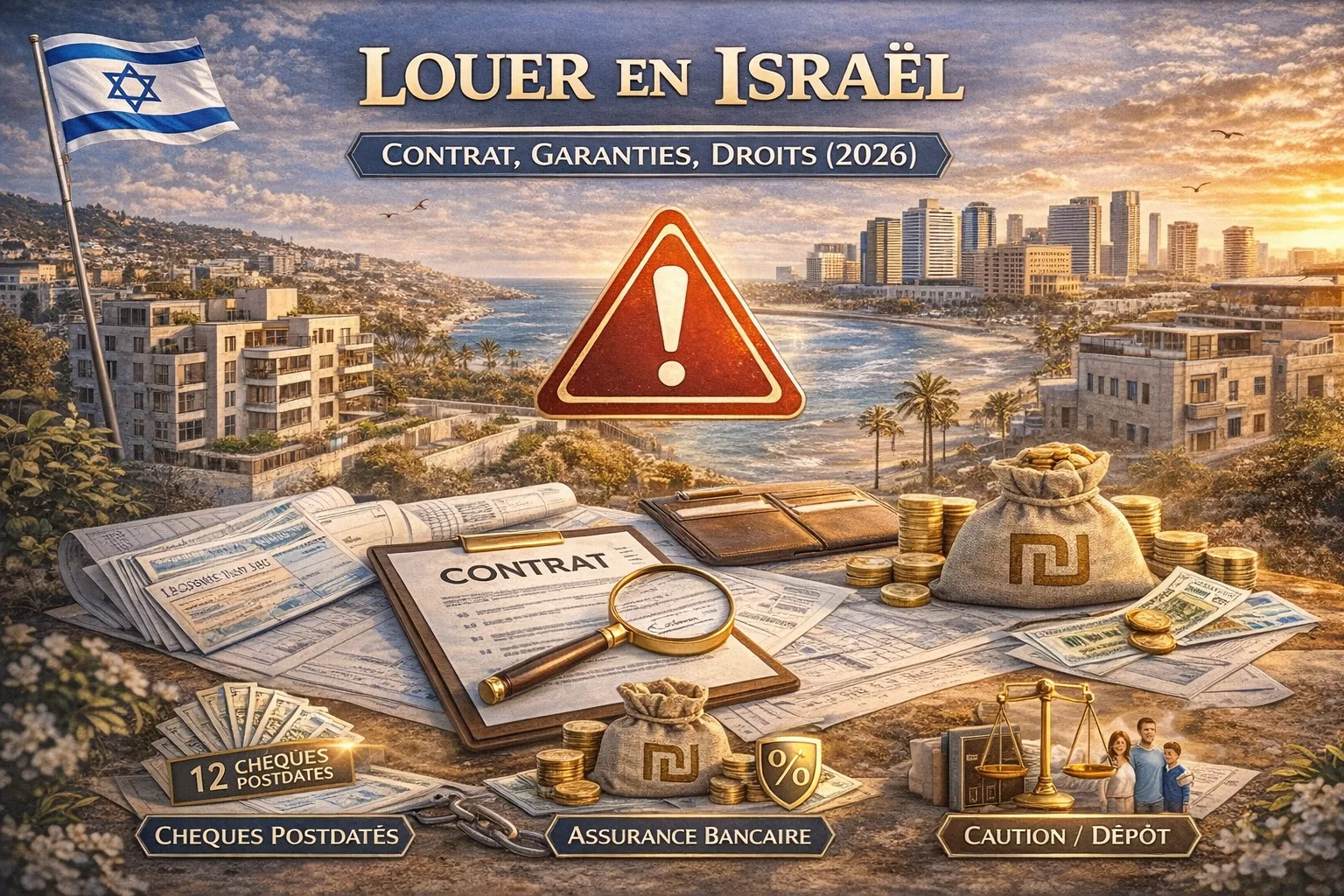
In Israel, rent is usually paid bypost-dated checks (hamcha'ot dated). When signing the lease, you give the landlord 12 checks (one per month), each dated the first of the corresponding month. The landlord cashes them one by one over the months.
This system may surprise French people used to automatic transfers. It requires having anIsraeli bank account with a checkbook, and ensuring the account is funded each month on the check date.
💡 Alternative: Some landlords accept monthly bank transfers (ho'raat keva — automatic debit). It's more modern and safer for both parties. Don't hesitate to suggest it, especially if you're a good tenant profile.
The rent amount
Rents are not subject to any regulation. No ceiling, no reference index, no limitation on increases. When renewing the lease, the landlord can request whatever increase they want. The tenant can accept, negotiate, or leave.
Rents are generally expressed inshekels, but in Francophone or Anglophone communities, some landlords advertise in dollars or euros. Check the contract currency and the exchange rate applied.
Required guarantees
The landlord will require several forms of guarantee to protect against unpaid rent and damage. The accumulation may seem excessive for a French person, but it's the norm in Israel.
Common guarantees
Type of guarantee | Typical amount | How it works |
|---|---|---|
Deposit (pikadone) | 1 to 3 months' rent | Check or transfer kept by the landlord, returned at the end of the lease |
Bank guarantee (arevout bankaït) | 3 to 6 months' rent | The bank guarantees payment if you default |
Promissory note (shtar hov) | Variable (often high) | Commitment to pay a sum in case of breach |
Guarantors (arevim) | — | People who commit to pay if you don't pay |
Guarantee checks | 2 to 6 months' rent | Undated checks, cashed only in case of problems |
⚠️ Protect yourself: Never let the landlord cash your deposit freely. Require that the deposit be held in escrow with a lawyer, or at minimum that the contract precisely stipulates the conditions under which the deposit can be used and the refund deadline.
💡 Negotiation tip: The more solid profile you present (stable job, proven income, local guarantors), the more you're in a position to negotiate guarantees downward. A landlord will prefer a reliable tenant with fewer guarantees than a doubtful file with many guarantees.
Distribution of charges
What the tenant pays
As a general rule, the tenant takes charge ofcurrent expenses related to occupying the property:
Arnona (municipal tax) — it's the occupant who pays, not the landlord. Arnona represents a significant monthly cost (several hundred shekels depending on the city and area).
Water and electricity — in your name or sub-meter.
Vaad bait (current building charges) — building maintenance, cleaning, common area lighting, elevator.
Gas — if the property is equipped with gas.
What the landlord pays
The landlord assumesstructural expenses and major works:
Building works — facade renovation, roofing, waterproofing, structural reinforcement. These are not current charges but investments in the building.
Major repairs — replacement of an obsolete water heater, main plumbing repair, electrical problems related to the installation (not usage).
Equipment depreciation — if the air conditioner, refrigerator or washing machine provided by the landlord breaks down due to normal wear (not misuse), it's in principle the landlord's responsibility to replace them.
⚠️ Beware of the contract: Some landlords add clauses that transfer to the tenant responsibility for ALL repairs, including structural ones. This is not in accordance with the spirit of the law. Negotiate to restore fair distribution, or have the contract reviewed by a lawyer.
Arnona: exemptions for olim
If you areolé hadash (new immigrant), you can benefit from a reduction of up to90% of the arnona during the first 12 months, then decreasing reductions in following years. To benefit, register with the municipality upon moving in with your teudat oleh.
💡 Good to know: The arnona exemption for olim applies whether you're an owner or tenant. Many newcomers don't request it due to ignorance and pay full price. Don't make this mistake.
Tenant rights and obligations
Your rights
Peaceful enjoyment of the property — the landlord cannot enter your home without notice or without your agreement (except emergency).
Deposit refund — at the end of the lease, if the property is returned in good condition, the landlord must return the deposit within the timeframe provided in the contract. In case of dispute, it's up to the landlord to prove damage, not for you to prove your innocence.
Finding a replacement — if nothing is provided in the contract and you wish to leave before the end of the lease, the law allows you to find a replacement tenant who takes over the lease under the same conditions. The landlord cannot refuse without valid reason.
Your obligations
Pay rent on time — payment delays (bounced checks) can trigger contract penalty clauses and justify eviction proceedings.
Maintain the property in good condition — damage related to your use is your responsibility. Maintain the property normally as a reasonable person would.
Respect building regulations — noise, animals, use of common areas: the building rules apply to you.
Do not sublet without agreement — subletting (including Airbnb) requires written agreement from the landlord and may be prohibited by building regulations.
Lease termination
Normal end of lease
At the end of 12 months, the lease ends automatically — unless an automatic renewal clause is provided. The landlord and tenant then negotiate renewal: new rent, new duration, same conditions or modified conditions.
Early termination by tenant
If you must leave before the end of the lease, check the contract. Three scenarios:
The contract provides for notice — respect the deadline (often 60 to 90 days) and you're free.
The contract provides nothing — the law allows you to find an acceptable replacement for the landlord. Once the replacement is found and accepted, you're released from your obligations.
The contract prohibits any early exit — it's rare but it exists. In this case, you remain committed until the end of the lease, except by amicable negotiation.
💡 Advice: Before signing, systematically negotiate an early exit clause with 60 days' notice. It's an essential safety net, especially if you're new to the country and your situation may evolve.
Eviction by landlord
The landlord cannot put you out overnight. Even in case of unpaid rent, they must go throughjudicial proceedings. The law provides for a simplified and accelerated procedure for non-payment cases, but it still takes several weeks to several months.
Furnished vs unfurnished rental
In Israel, the majority of rentals are offeredunfurnished — that is, with an equipped kitchen (burners, oven, possibly hood), wall air conditioners, water heater, and sometimes a washing machine. But no furniture, no beds, no sofa.
Rentalsfurnished are more common in tourist areas (Eilat, Tel Aviv center) or for short-term leases. The rent is naturally higher.
💡 Tip: If you arrive in Israel and need to furnish an apartment quickly, Facebook resale groups among Francophones are a goldmine. Olim who are leaving or moving often resell their furniture at very low prices.
Vacation rental (Airbnb, short stays)
Seasonal rental is a separate market in Israel. It's popular inEilat,Tel Aviv,Jerusalem andNetanya during holiday periods and summer vacations.
As a tenant
If you're looking for vacation accommodation in Israel, platforms like Airbnb, Booking.com, and specialized sites work well. Check reviews, actual location (not just the announced neighborhood), and cancellation conditions.
As an investor-landlord
If you're considering buying for seasonal rental, know that taxation issignificantly less advantageous than long-term rental. Seasonal rental income is considered commercial activity, taxed at progressive rates, and subject to VAT above the threshold.
Some municipalities also impose specific regulations on tourist rental (license, maximum duration, etc.).
See vacation rentals on immobilier.co.il →
Checklist before signing a lease
Before the visit:
Define your total budget (rent + arnona + charges + insurance). Prepare your income proof, ID, and identify potential guarantors.
During the visit:
Check the condition of walls, plumbing, electricity, air conditioning, windows, insulation. Ask for the exact amount of arnona and vaad bait. Check water pressure and operation of all equipment.
Before signing:
Have the contract translated if you don't read Hebrew. Negotiate an early exit clause. Check the distribution of charges and repairs. Document the property condition with photos. Ensure deposit refund conditions are clear.
After signing:
Register with the municipality for arnona. If you're olé hadash, immediately request the exemption. Transfer water and electricity to your name. Take out home insurance (highly recommended).
Also read
👉Back to Ultimate Real Estate Guide for Israel
👉The buying process — 8 essential steps
👉Mashkanta — financing your purchase in Israel
👉Taxation — mas rechisha, mas shevach, arnona
👉Best cities to invest in Israel
👉Buying off-plan — new projects, Tama 38
👉10 pitfalls to avoid in Israeli real estate
See all rental properties on immobilier.co.il →
This guide is provided for informational purposes. Rental regulations in Israel evolve — the government regularly considers reforms. Consult a professional for advice adapted to your situation. Last update: March 2026.
immobilier.co.il — The real estate portal in Israel since 2004.