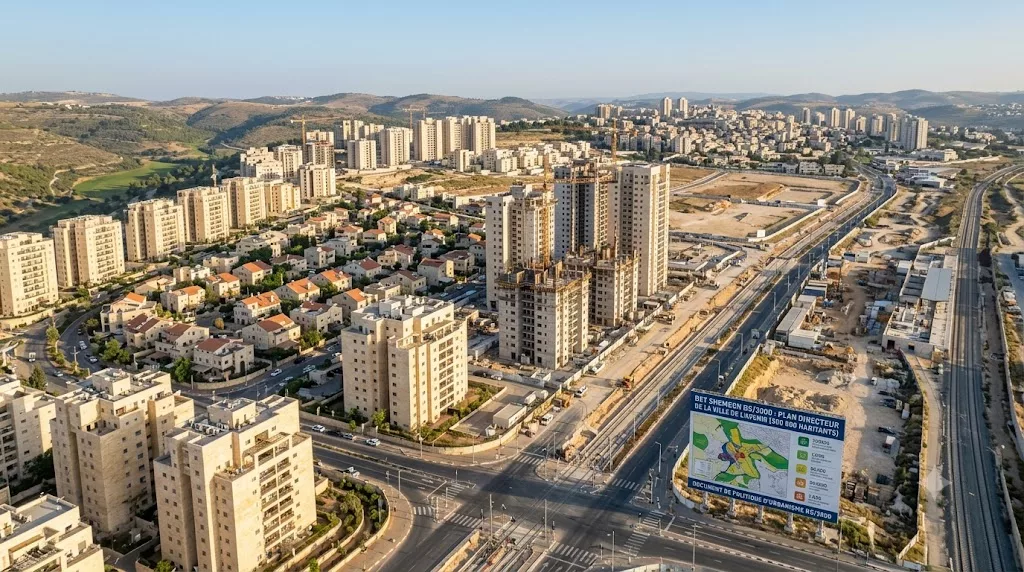
On June 23, 2026, the Jerusalem District Committee approved the advancement of the urban policy document BS/3000 — the master plan that charts the future of Bet Shemesh for the coming decades. The conclusion of this document is unequivocal: the city is set to grow from 185,000 to over 500,000 residents. This is not a political promise. It is an official planning framework, approved by the most competent district committee in the matter. For anyone — in New York, Paris, Buenos Aires, Moscow or Tel Aviv — watching Israel as an investment or living destination, this vote deserves close attention.
What the BS/3000 Plan Actually Contains
The BS/3000 document is not a statement of intent. It is a detailed planning framework, validated by official authorities, that sets precise building rights and a binding overall vision for all future decisions in the city.
Concretely, the plan provides for the addition of 66,000 housing units, bringing the total stock to approximately 111,000 units. For employment and commerce, an additional 2.3 million m² are planned — bringing the total to 2.9 million m². Industry gains an additional 1.8 million m², for a total of 4.5 million m². The city also gains 750 hotel rooms, a transport network including heavy rail, light rail (LRT) and bus rapid transit (BRT), and freight terminals. In the southern city center, towers of up to 23 floors are permitted on certain plots designated as exceptional height zones. Along the main arteries — Jordan River Boulevard, Nahal Kishon, Isaiah the Prophet Street — renovations and reconstructions may reach 9 floors, with a requirement for active commercial ground floors.
Mayor Shmuel Greenberg described the decision as "a historic recognition of Bet Shemesh's status". Deputy Mayor Shimon Goldberg, chairman of the local planning committee, was even more direct: "The district committee said it clearly and unequivocally: Bet Shemesh is the city of the future in the Jerusalem district."
Bet Shemesh: Already a Global Diaspora City
What makes this decision particularly significant for diaspora Jews is that Bet Shemesh has long been one of the cities where they settle most naturally. The neighborhoods of Ramat Bet Shemesh Aleph, Gimmel and Neve Shamir are home to one of the largest American communities in Israel — thousands of families from the United States, Canada, the United Kingdom, South Africa and Australia, predominantly modern Orthodox. The French community is also well represented, particularly among dati leumi families settled in newer neighborhoods.
The reasons for this appeal are numerous. Bet Shemesh is connected to Jerusalem (25 minutes by train) and to Tel Aviv (less than an hour). The rail line has transformed the city's accessibility. Highway 38 has been significantly widened. English- and French-speaking school infrastructure — schools, kollelim, synagogues — is among the most developed in Israel outside the major cities. And prices were, until recently, more affordable than Jerusalem.
This is precisely the point that deserves close examination.
Price Performance: +66.4% in Seven Years, a National Record
According to CBS data analysis published by the Nadlan Center, the average price of a 4-room apartment in Bet Shemesh stood at 2.27 million NIS (~$631,000 USD) in the third quarter of 2024 — compared to 1.36 million NIS in 2017. That represents a rise of 66.4% in seven years, the highest among all Israeli cities with more than 100,000 residents. By comparison, Tel Aviv rose 44.1% over the same period (4.87 million NIS in Q3 2024, ~$1,350,000 USD), Jerusalem by 46.9% (3.08 million NIS, ~$856,000 USD), and Beer Sheva by only 23.4%.
Early 2026 transactions show that the market has continued its upward trend: 4- to 5-room apartments are trading between 2.4 and 2.75 million NIS (~$667,000 to $764,000 USD) depending on the neighborhood and floor. These amounts remain nearly half the equivalent Jerusalem price and more than two-thirds below Tel Aviv.
This differential is explained by persistent structural factors. On one hand, Bet Shemesh is geographically constrained by the Elah Valley and surrounding green spaces — the city cannot expand indefinitely, which maintains pressure on supply. On the other hand, demand is continuously driven by two distinct engines: the ultra-Orthodox community, which constitutes the main pool of local buyers, and the English- and French-speaking diaspora seeking a foothold in Israel without paying Jerusalem prices.
What the BS/3000 Plan Changes for a Diaspora Buyer
It is important to be precise about what the approval of the BS/3000 document means. It is not a building permit: it is an urban policy framework. The road between this document and the first homes delivered in the new zones is long — several years of procedures, tenders, and construction. The population will not jump to 500,000 overnight.
What this vote immediately changes, however, is the official visibility of Bet Shemesh as a major Israeli city. The district committee wrote that the city is "a significant urban anchor in the Jerusalem district" that deserves to be developed through densification and strengthening of its urban continuity. It is no longer a secondary city being watched — it is a city being planned on a generational horizon.
For a diaspora buyer, this changes several equations. Uncertainty about the city's future disappears: with a validated master plan, the planned transport infrastructure (heavy rail, light rail, BRT) will be delivered as it is now enshrined in the district's official policy. Areas identified as densification corridors along the main arteries will become axes of increased value. And existing neighborhoods — Ramat Bet Shemesh Aleph and Gimmel in particular — will benefit from the appeal of a city structuring itself as a metropolis.
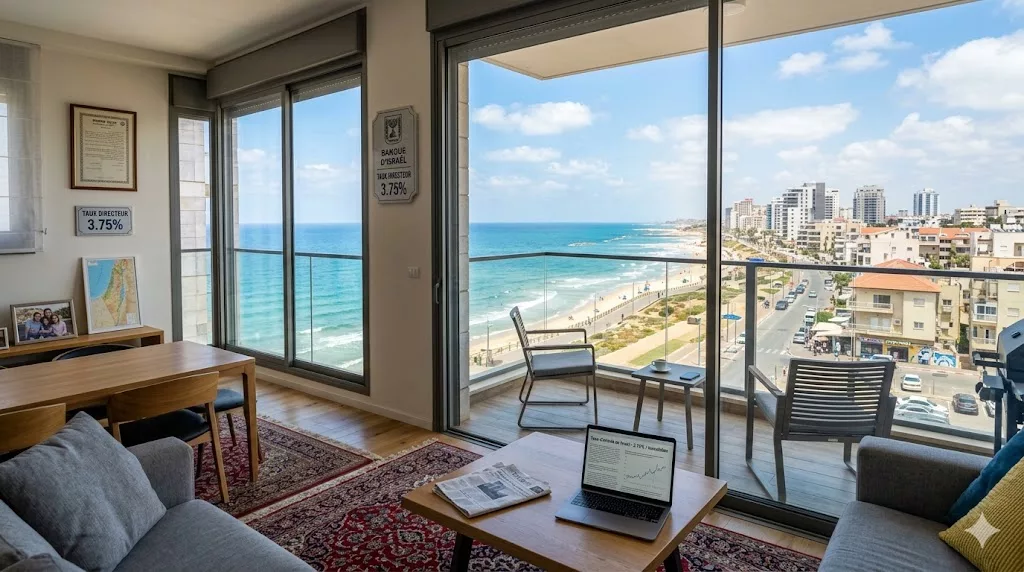
With the Bank of Israel rate at 3.75% since the May 2026 decision — the lowest in three years — mortgage financing conditions are also more favorable than they have been since before the war.
To understand the concrete steps involved in buying from abroad, from financing to registration at the Tabo, consult our Ultimate Guide to Real Estate in Israel.
Find all real estate listings in Bet Shemesh, Ramat Bet Shemesh and across Israel on Immobilier.co.il.