Contrary to a still very widespread misconception, making Aliyah is absolutely not a condition for buying real estate in Israel. A French, Belgian, Swiss, Canadian or any other foreign national can acquire an apartment in Tel Aviv, a villa in Netanya or a pied-à-terre in Jerusalem without ever becoming an Israeli citizen or resident. The procedure is legal, regulated and perfectly accessible — but it differs significantly from that of a resident buyer or new immigrant. Mas Rechisha increased to 8% from the first shekel, minimum personal contribution of 50% to obtain a mashkanta, power of attorney drafted by an Israeli lawyer to sign remotely, and essential coordination with your original tax residence. This guide details, in 2026, everything you need to know to buy in Israel without making Aliyah.
Non-resident or new immigrant: two very different paths
Confusion is frequent, but the distinction is fundamental in the eyes of the Israeli tax administration. An Oleh Chadash (new immigrant) is a person who made Aliyah and obtained Israeli citizenship — he benefits as such from a privileged tax regime on his first real estate purchase, notably via an advantageous progressive scale of Mas Rechisha that can start at 0%. Conversely, a non-resident (Toshav Chuts) is a foreigner who buys from his country of origin and does not intend, for the time being, to settle permanently in Israel.
The implications are concrete. For the same apartment at ₪2,000,000, an Oleh Chadash will pay about ₪20,000 in purchase tax, while a non-resident will pay ₪160,000 — eight times more. The contribution required by banks also differs: 25 to 30% for a resident, 50% for a non-resident. Before launching your project, it is therefore essential to clearly identify your status. If you are considering making Aliyah in the medium term, it may be relevant to postpone the purchase until obtaining Oleh status — and in that case, our article Real estate purchase advantages for new immigrants is more suitable. If you are buying from France for a pied-à-terre, a rental investment, or a secondary residence intended for your children, this guide is for you.
Remote procedures from France or abroad
Buying in Israel without going there is entirely possible. Many French-speaking buyers complete their entire transaction from Paris, Brussels, Geneva or Montreal. Three tools make this possible: legal power of attorney, remote bank account opening, and representation by a trusted lawyer and agency.
Power of attorney to an Israeli lawyer (Ipuï Koah)
The cornerstone of a remote purchase is the notarized power of attorney, called in Hebrew Ipuï Koah. Drafted by your Israeli lawyer, it delegates to him the powers to sign the preliminary agreement, pay deposits, carry out procedures at the Tabu (land registry), and represent you before banks. The document must be signed before a notary in France, then apostilled and translated — or signed directly at the Israeli consulate. Allow one to two weeks to obtain a power of attorney fully enforceable in Israel.
Non-resident bank account opening
Without an Israeli bank account, no transaction is possible: funds must necessarily transit through a local bank. The main banks accepting non-residents — Bank Leumi, Bank Hapoalim, Bank Discount, Mizrahi Tefahot — offer Toshav Chutsaccounts, which can be opened remotely with supporting documents: passport, proof of address, foreign bank statements, and in some cases a video conference interview. Allow four to six weeks for effective opening, and check account maintenance fees as well as international transfer commissions, often higher than in France.
Virtual visits and representation by a French-speaking agency
If you cannot travel, serious Israeli real estate agencies offer guided visits by video conference, detailed videos and photo reports. For French-speaking buyers, working with a French or bilingual agency is a major asset — both for translation and for cultural understanding of the market. The platform Immobilier.co.il lists more than 110 French-speaking partner agencies and 475 local agents capable of representing you physically.
Heavier taxation for non-residents
This is probably the biggest difference between a resident purchase and a non-resident purchase: Israeli taxation significantly tightens the rules for foreign buyers who do not reside fiscally in Israel.
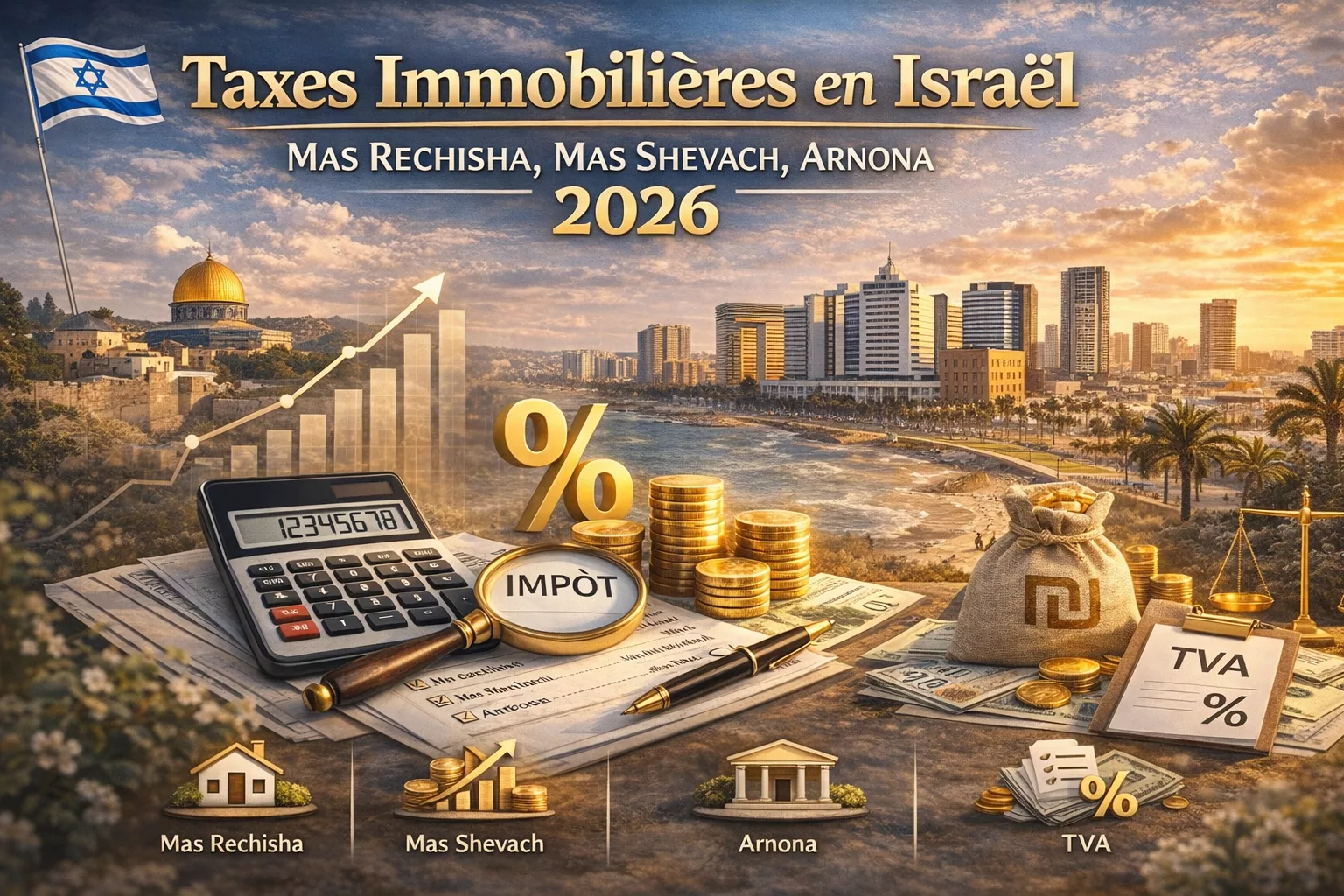
Mas Rechisha: 8% from the first shekel
The Mas Rechisha is the Israeli purchase tax. For an Israeli resident buying his only residence, the scale is progressive and starts at 0% on the first bracket. For a non-resident, the scale is much harsher: 8% from the first shekel up to about ₪6,055,070 (2026 scale), then 10% beyond. An apartment at 3 million shekels will therefore generate ₪240,000 in tax alone. This charge must necessarily be integrated into the overall budget from the start.
Mas Shevach (capital gains on resale)
In case of subsequent resale, capital gains are taxed at 25% of the net gain for a non-resident. Unlike a resident who can benefit from an exemption on his main residence every 18 months, no duration reduction is provided for non-residents. This is a point often ignored by foreign buyers who buy with speculative logic.
Arnona and current charges
Arnona is the Israeli municipal tax, equivalent to housing tax. It is payable by the occupant: if you rent the property, it is the tenant who pays it; if the property is vacant or occupied by yourself during stays, it is you. Some municipalities grant reductions to secondary residences with low occupancy rates, but this is not automatic.
For a complete detail of taxes and possible optimizations, consult our dedicated article: Real estate taxes in Israel: Mas Rechisha, Mas Shevach, Arnona (2026).
Financing your purchase from abroad: the non-resident mashkanta
Israeli banks grant real estate loans — called mashkanta — to non-residents, but under stricter conditions than to local residents.
The minimum required contribution amounts to 50% of the property price, where an Israeli resident can obtain a mashkanta covering 70 to 75% of the acquisition. Concretely, for an apartment at 2 million shekels, you will need to have 1 million in own funds, with the bank financing the remaining million over 20 to 25 years. Rates vary greatly according to your profile: income, tax residence, age, professional stability. For a French-speaking non-resident with stable income, count in 2026 global effective rates oscillating between 5% and 7%, often partially indexed on Israeli inflation.
The banks most open to French-speaking non-resident profiles remain Bank Leumi and Bank Hapoalim, which have specialized "French desk" advisors in Tel Aviv and Jerusalem. Mizrahi Tefahot and Bank Discount also offer competitive solutions. Systematically have offers established from at least two institutions: the differences can represent several tens of thousands of shekels over the loan duration.
To deepen the subject of financing, consult our complete guide: Real estate credit (Mashkanta): financing your purchase in Israel.
Tax implications in your country of origin
Buying in Israel as a non-resident does not free you from your tax obligations in your country of residence. For a French tax resident, three mechanisms must be anticipated.
3916 declaration: Israeli bank account
Any French tax resident holding a bank account abroad must declare it each year to the tax administration via form 3916 (annexed to the income tax return). Failure to declare exposes to significant fines — up to €1,500 per undeclared account, and €10,000 for accounts in non-cooperative states. Israel is not concerned by the aggravated increase, but the declaration remains mandatory.
Rental income declaration (form 2044)
If you rent the property, rents received in Israel must be declared in France on form 2044. The Franco-Israeli tax treaty of 1995 provides for taxation in the country where the building is located (therefore Israel) and an equivalent tax credit in France to avoid double taxation. In practice, this means you declare rents in France but do not pay tax twice — it is credited.
Real Estate Wealth Tax (IFI)
If your worldwide real estate assets (including the Israeli property) exceed €1,300,000 on January 1st, you are subject to IFI in France. The Israeli property enters the base, at its market value, possibly reduced by the current mashkanta. Anticipate this mechanism from the decision phase: an investment of 2 million shekels in Israel can tip assets previously not taxable into IFI.
For Belgian, Swiss or Canadian residents, the principles are similar but tax treaties and taxation thresholds differ. In all cases, a preliminary exchange with a French tax lawyer mastering international taxation and an Israeli lawyer specialized in real estate is essential.
Cities favored by French-speaking non-resident buyers
While opportunities exist throughout Israel, certain cities concentrate most of the French-speaking non-resident demand — for cultural, community and practical reasons.
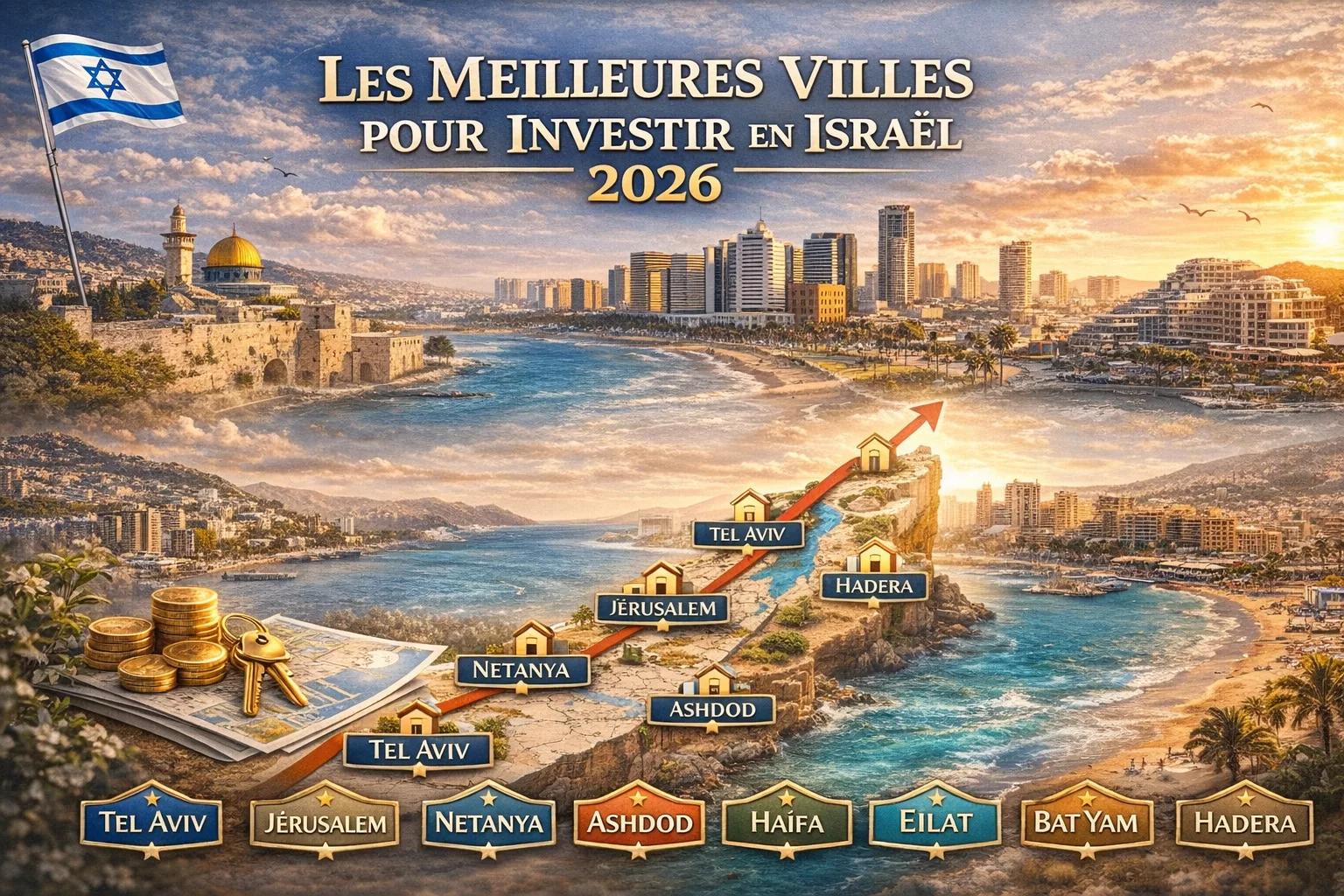
Netanya, nicknamed "Paris-on-Sea", is historically the first destination for French-speaking buyers. Dense French community, French-speaking schools, synagogues, bakeries, restaurants: integration is immediate. The Ir Yamim district, more recent, attracts wealthy families and investors. See properties for sale in Netanya.
Jerusalem attracts buyers seeking spiritual or family anchoring. The Rehavia, Talbieh, German Colony and Baka districts concentrate French-speaking demand. Prices are high but the market is extremely resilient. See properties for sale in Jerusalem.
Tel Aviv targets primarily high-end investors: Neve Tzedek, Rothschild, North Tel Aviv. Lower rental yield, but constant appreciation and ultra-liquid market. See properties for sale in Tel Aviv.
Ashdod attracts the French-speaking Sephardic community, with more accessible prices than Tel Aviv, a beach, and solid French-speaking infrastructure. See properties for sale in Ashdod.
Ashkelon and Raanana complete the podium: Ashkelon for tighter budgets and direct sea access, Raanana for families seeking a high-end residential setting and international schools. See properties in Ashkelon and in Raanana.
For a detailed comparison by city — price per square meter, rental yield, buyer profile — consult our analysis: Where to invest in Israel? Comparison of the best cities (2026).
Frequently asked questions — non-resident buyers
Yes. With a notarized power of attorney entrusted to an Israeli lawyer, the entire transaction can take place without your physical presence. A preliminary visit is nevertheless strongly recommended, at least for choosing the neighborhood and property.
No. Your lawyer, your agency and your banker can work in French or English. All official documents can be translated, and contracts are regularly drafted in bilingual version.
No, provided you have correctly declared your Israeli bank account (form 3916) and your possible rental income (2044). Real estate purchase abroad is perfectly legal, it is simply declarative.
Yes, absolutely. Many buyers start with a non-resident purchase then make Aliyah later. Be careful however: the benefit of reduced Mas Rechisha for Oleh Chadash applies to the first purchase after Aliyah, not retroactively on a property already acquired.
Counting the property price, Mas Rechisha at 8%, lawyer fees (about 1.5% of price + VAT), Tabu fees and the 50% contribution, a serious project starts around €400,000 to €500,000 in own funds for a decent apartment in a French-speaking city.
The Tabu (Tabo in Hebrew, "Mirsham HaMekarkéïm") is the Israeli land registry, equivalent to the French cadastre and mortgage registry. It is the registration at the Tabu that makes you the official owner of the property, not the signing of the sale deed.
In Israel, there is no notary in the French sense. It is thereal estate lawyer who secures the transaction, verifies the property title, drafts the contract and carries out procedures at the Tabu. His role is central and not optional.
For an existing property, count between 3 and 6 months between signing the preliminary agreement and handing over the keys. For an off-plan property (new project), the deadline is naturally longer and depends on the developer's delivery schedule.
Yes, but Israeli municipalities increasingly regulate short-term rentals, notably in Tel Aviv and Jerusalem. Check local regulations and condominium rules before buying with this in mind.
The property enters your succession, which is governed by French law or the European regulation on international successions (regulation 650/2012). There are no inheritance taxes in Israel since 1981, but heirs may be taxed in France on the property value. Anticipation via dismemberment or real estate investment company may be relevant — consult a specialized lawyer.
Ready to get started?
Buying in Israel without making Aliyah is accessible, legal and secure as long as the right steps are followed. The essential comes down to four points: choose a competent Israeli lawyer before even looking for a property, anticipate heavier taxation, prepare a contribution of at least 50%, and secure your declarative obligations in France. The rest is a matter of method and patience.
To start your project, explore our selection ofapartments and villas for sale in Israel, consult the Ultimate Real Estate Guide in Israel for an overview, or contact one of our French-speaking partner lawyers for an initial consultation.