Meta title:Off-plan buying in Israel: new projects, Tama 38, guarantees (2026)
Meta description:Everything about new property purchases in Israel: developers, bank guarantees, payment schedule, VAT, Tama 38, Pinouyi Binouyi, buying groups. Benefits, risks and advice.
Slug:off-plan-buying-new-projects-israel
Category:ultimate-guide
Tags:new project israel, off-plan buying, developer israel, kablan, tama 38, pinouyi binouyi, bank guarantee, buying group, property VAT, new construction
(This block is for you, do not publish)
Off-plan buying in Israel: new projects, Tama 38 and buying groups
Off-plan purchases from developers (kablan) represent a significant portion of the Israeli real estate market. Major urban renewal projects, chronic housing shortages and the government's desire to modernize the housing stock create a constant flow of new developments in all cities across the country.
It's a real opportunity: buying a new property to the latest standards, customizing certain finishes, and sometimes benefiting from capital appreciation between signing and delivery. But it's also a commitment over 2 to 4 years, with specific risks that buyers of existing properties don't encounter.
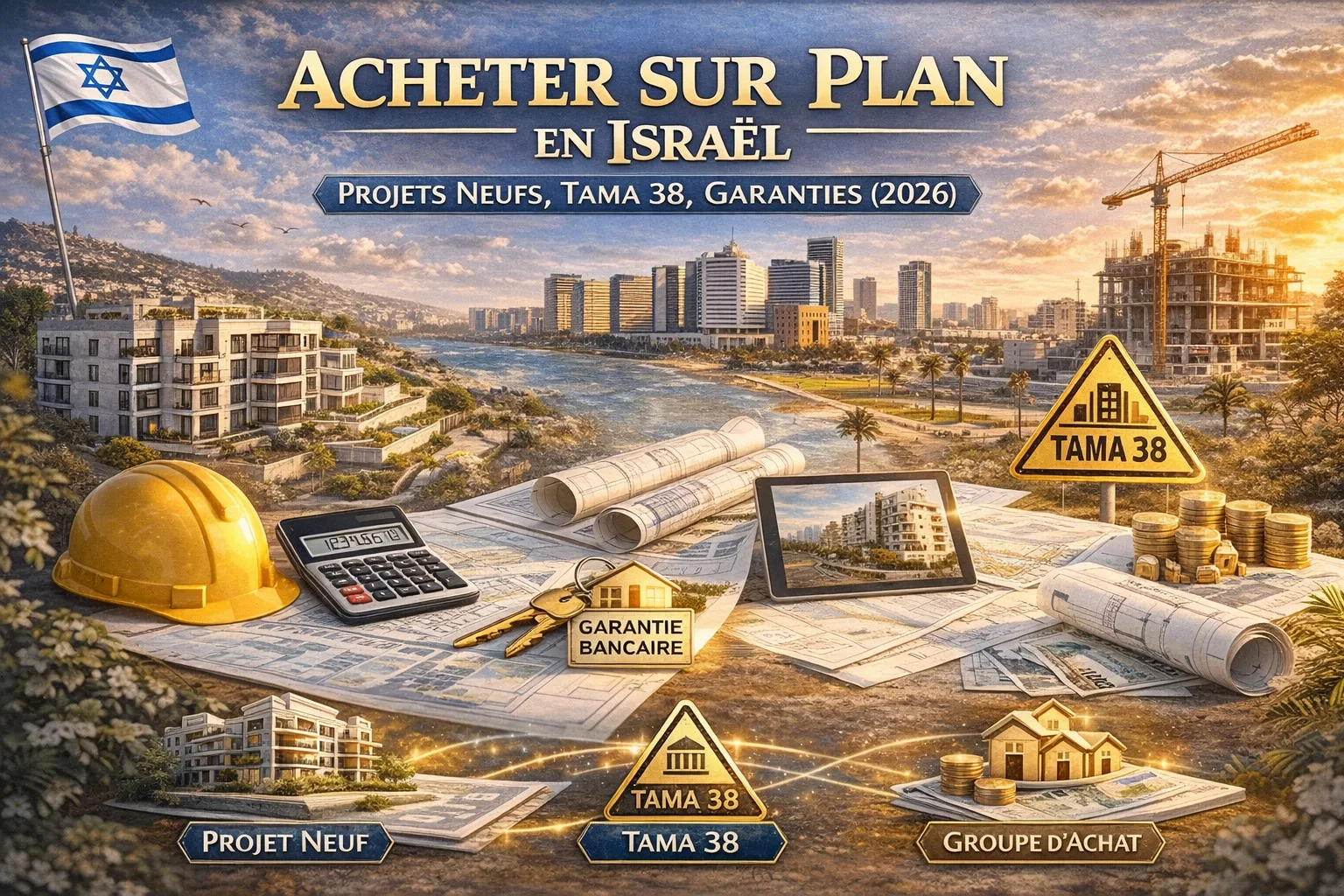
This guide covers the three main forms of new property purchases in Israel: traditional developer purchases, Tama 38 / Pinouyi Binouyi projects, and buying groups.
📖 This article is part of theUltimate Real Estate Guide for Israel
Traditional developer purchases (kablan)
How it works
You buy an apartment that doesn't exist yet — off-plan or under construction. The developer shows you the plans, a model or a show apartment, you choose your unit (floor, orientation, size), and you sign a contract that commits the developer to deliver the finished property by a specified date.
Payment is spread over the entire construction period, according to a schedule set in the contract. You don't pay everything at once — payments follow the progress of construction work.
Typical payment schedule
Milestone | Percentage | Detail |
|---|---|---|
Contract signing | 10 — 20 % | First payment |
Building permit obtained | 10 — 15 % | If not yet obtained at signing |
Foundation completion | 10 — 15 % | Construction progress |
Structure completed (shelad) | 15 — 20 % | Shell and core finished |
Finishing work | 10 — 15 % | Plumbing, electricity, tiling |
Key handover | 15 — 20 % | Final balance on delivery |
💡 Financial advantage:The payment schedule gives you time to build up your down payment or arrange your mashkanta. Some buyers even resell before delivery if the market has risen — this is legal but subject to mas shevach (capital gains tax).
Legal guarantees
Israeli law (Hok HaMekhira — apartment sales law) requires developers toprotect every paymentyou make. Until the property is delivered and a notation is registered in your favor in the land registry, the developer must provide one of the following guarantees:
Bank guarantee (arevout bankaï): the bank guarantees reimbursement of your funds if the project fails. This is the strongest protection.
First mortgageon the land in favor of the buyer.
Insurance policycovering the amounts paid.
Registration of a right (he'arat azhara)at the Tabu on the land.
⚠️ Critical point:Check that guarantees cannot be canceled by the developer before delivery AND registration of a notation in the land registry in your name. Your lawyer must carefully verify this point — it's what protects you if the developer goes bankrupt during construction.
Construction warranties (after delivery)
The law provides forwarranty periodsfor each aspect of construction. The developer is responsible for defects and poor workmanship during these periods:
Item | Warranty (bdeq) | Structural liability (ahrayout) |
|---|---|---|
Structure and foundations | 3 years | 20 years |
Waterproofing | 3 years | 10 years |
Plumbing and sanitary | 1 year | 3 years |
Electricity | 1 year | 3 years |
Tiling and finishes | 1 year | — |
The "bdeq" (inspection) period requires the developer to repair any defect you report. The "ahrayout" (liability) period covers deeper flaws that appear later. Document all defects found, in writing and with photos, from the moment you move in.
The price: what's included and what's not
The price advertised by the developerincludes 17% VAT. But it generally doesn't include options and modifications you might request (material changes, additional outlets, partition modifications). These extras are charged separately and can quickly add up.
⚠️ Don't forget:In addition to the VAT-inclusive price, you must pay the mas rechisha (acquisition tax) calculated on the total price including VAT. This is the double tax effect of new properties that many underestimate.
Delivery deadlines
The contract stipulates a delivery date — or a deadline after obtaining the building permit. In practice, delays are frequent. The developer always reserves a clause for extension due to "reasons beyond their control" (weather, strikes, material shortages).
The law protects buyers: beyond a certain delay, the developer must compensate you. Compensation is set at1.5 times the equivalent rentfor the first 8 months of delay, then1.25 timesthereafter. Your lawyer must contractually limit the duration of authorized extensions.
Tama 38 — Seismic reinforcement
The principle
Tama 38 is a national planning scheme launched after awareness of seismic risks in Israel. It concerns buildings constructedbefore 1980that don't meet current seismic standards. The idea is simple: a developer takes charge of reinforcing the building, and in exchange, receives additional construction rights (extra floors, extra apartments) that they can sell.
What property owners gain
Without spending a shekel, existing owners can obtain: structural reinforcement of the building, addition of an elevator, expansion of their apartment (mamad — safe room, balcony), renovation of common areas, and sometimes parking. All without improvement tax (hetel hashbacha) thanks to the program's tax exemptions.
Tama 38/1 vs Tama 38/2
Tama 38/1(reinforcement): the existing building is preserved and reinforced. The developer adds floors above and expands existing apartments. Residents stay in their homes during construction (with the resulting inconveniences).
Tama 38/2(demolition-reconstruction, also called Pinouyi Binouyi): the building is completely demolished and rebuilt. Residents are temporarily relocated and receive a new, larger apartment in the new building. It's more radical but the result is an entirely new building.
⚠️ The risks:In a Tama 38 project, property owners transfer part of their construction rights to the developer. The contract must be examined with extreme care: relocation guarantees, deadlines, quality of finishes, delay penalties, rights registration. Banks themselves impose strict conditions to finance this type of project.
What if some property owners refuse?
Unanimity is not always required. The law allows launching a Tama 38 project with a qualified majority of property owners (generally 66% for Tama 38/1 and 80% for Pinouyi Binouyi). Holdouts can be compelled by court order. This is a sensitive issue that generates many disputes.
Buying groups (Kvoutzat Rechisha)
The principle
A group of buyers comes together to jointly acquire land, obtain building permits, and have an apartment building constructed by a contractor — allwithout a developer. The theoretical advantage is economic: eliminating the developer's margin and paying acquisition tax only on the land (not on the building), which considerably reduces the mas rechisha.
The advantages
The final price is potentially20 to 30% lowerthan a comparable purchase from a developer. Acquisition tax is calculated on the land alone, not on the finished apartment. And group members have a say in plans, materials and contractors.
The risks (considerable)
Unlike purchasing from a developer, buying groups arenot regulated by apartment sales law. Legal protections (automatic bank guarantees, delay compensation, construction warranty periods) don't apply in the same way.
The price is not fixed.If the project costs more than expected (delays, cost overruns, municipal requirements, connections), the group pays the difference. There's no developer to absorb overruns.
Guarantees are contractual, not legal.It's up to your lawyer to negotiate equivalent protections with the contractor and group organizer. Nothing is automatic.
Resale is complicated.Until completion and registration of units at the Tabu, you're a joint owner of land. Selling your "share" requires approval from the project bank and the group's lawyer.
⚠️ Our advice:A buying group can be an excellent deal IF you're well advised. But the risks are significantly higher than purchasing from a developer. Don't be swayed only by the low price — measure the cost of risk. And above all, never buy out a departing member's rights without thorough legal analysis of the project's situation.
New vs existing: how to choose?
Criteria | New (developer) | Existing (second-hand) |
|---|---|---|
Price | Higher (17% VAT included) | Less expensive (no VAT) |
Availability | 2 to 4 years waiting | 2 to 4 months |
Standards | Latest standards (seismic, insulation, mamad) | Standards of construction era |
Customization | Possible (for additional cost) | Work at your expense |
Warranties | Legal construction warranties | None (sold "as is") |
Risks | Delays, developer, modified plans | Hidden defects, illegal construction |
Financing | Staged (facilitates down payment) | All at once (or 3-5 quick payments) |
Mas rechisha | Calculated on VAT-inclusive price | Calculated on price |
💡 In summary:New properties suit you if you can wait 2-4 years and want "turnkey" to current standards. Existing properties suit you if you're looking for a specific location in an established neighborhood, with faster entry and potentially lower budget.
Checklist before signing with a developer
Before committing to a new property purchase, your lawyer must verify:
The building permit— is it already obtained? If not, the contract must include a cancellation clause if the permit isn't granted within a reasonable timeframe.
The developer's financial strength— balance sheet, delivered projects, reputation. A financially troubled developer may abandon a project in progress.
Bank guarantees— are they in place for each payment? Can they be canceled before delivery?
Contractual plans— plans attached to the contract bind the developer. Areas, layout, floor, orientation must correspond exactly to what was presented to you.
Deadlines and penalties— what is the delivery date? What is the extension clause? What are the penalties for delays?
Authorized modifications— does the developer reserve the right to modify plans? If so, to what extent? Do you have cancellation rights in case of substantial modification?
Land registry registration— what is the planned schedule for Tabu registration? Does the developer's lawyer contractually commit to a deadline?
Also read
👉Back to the Ultimate Real Estate Guide for Israel
👉The purchase process — 8 essential steps
👉The Mashkanta — financing your purchase in Israel
👉Taxation — mas rechisha, mas shevach, arnona
👉The best cities to invest in Israel
👉Off-plan buying — new projects, Tama 38
👉The 10 traps to avoid in Israeli real estate
See new projects on immobilier.co.il →
This guide is provided for informational purposes and does not replace advice from a specialized lawyer. Each new project has its contractual particularities. Last updated: March 2026.
immobilier.co.il — The real estate portal in Israel since 2004.