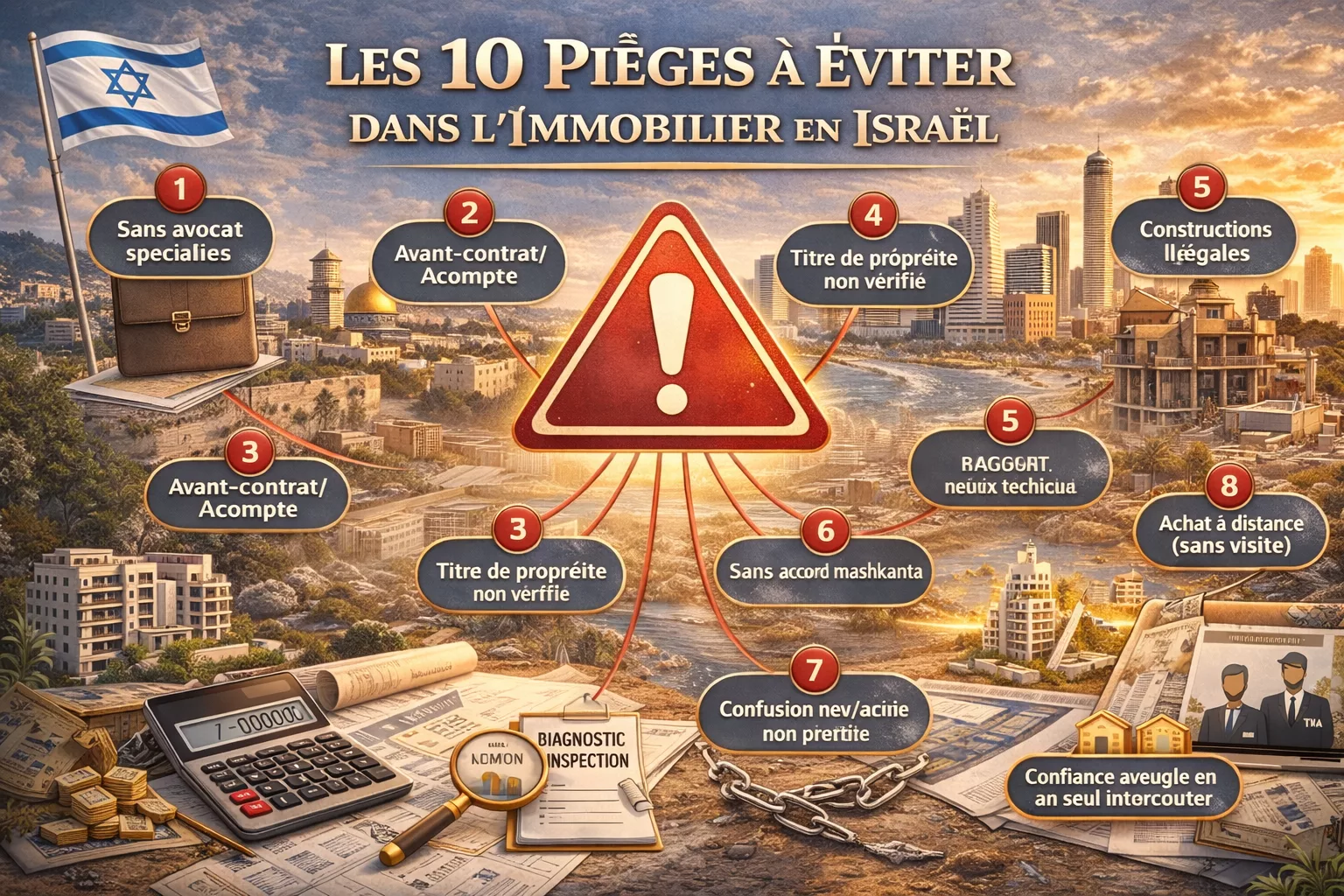
The 10 pitfalls to avoid in Israeli real estate
Over twenty years of activity in the Israeli market, we have seen hundreds of transactions go smoothly — and others turn into nightmares. The same mistakes keep recurring, among beginners as well as experienced buyers. Most of these pitfalls could have been avoided with good preparation and proper advice.
This guide lists the 10 most frequent and costly mistakes. If you should remember just one thing: never underestimate the particularities of the Israeli market, and never skimp on a good lawyer.
📖 This article is part of theUltimate Guide to Real Estate in Israel
Pitfall #1 — Moving forward without a specialized lawyer
This is the most serious and most common mistake. In Israel, there is no notary in the French sense. It's the lawyer specialized in real estate law who checks the property, drafts the contract, negotiates clauses, handles taxation, and registers with the land registry. Without them, you are blind.
Some buyers, to save on fees (1 to 1.5% of the price), ask a friend who "knows about it" or use the seller's lawyer. This is false economy with potentially disastrous consequences. The seller's lawyer defends the seller's interests, not yours.
⚠️ Absolute rule:Choose your lawyer BEFORE looking for a property. Each party must have their own lawyer. The fees are an investment, not an expense — they protect you against infinitely higher losses.
Pitfall #2 — Signing a preliminary contract or making a premature deposit
In France, the sales agreement is a normal and regulated step. In Israel, it's a trap. Most specialized lawyers formally advise against any written commitment before the final contract.
The reason is simple: under Israeli law, any document signed between the parties can be considered a binding contract. It will be very difficult to cancel if a problem appears later during legal verification. Even worse, a written commitment triggers a tax declaration obligation — you might have to pay the mas rechisha on a property you don't end up buying.
Real estate agents or impatient sellers may ask you to "block the property" with a guarantee check. Resist. The correct sequence is always: oral agreement on price → legal verification by your lawyer → final contract → first payment.
💡 What is normal:Oral negotiation, price discussions, multiple visits — none of this is binding. Only the contract drafted by lawyers commits you definitively.
Pitfall #3 — Not verifying the property title
In Israel, a property can be registered in several ways, and not all offer the same level of security. Registration in theTabu(land registry) is the best situation. But many properties are registered with a construction company, a state land administrator, or are in joint ownership.
Your lawyer verifies the nesach Tabu (cadastral extract) which reveals: the legal owner, mortgages, seizures, easements, rights of way, and entries recorded by third parties. This is the complete X-ray of the property.
Problematic cases: a property where the seller is not the true owner (unfinalized inheritance, ongoing divorce), land with construction restrictions, a plot in dispute with the State or municipality. Without verification, you might buy a problem, not an apartment.
⚠️ Frequent real case:An heir selling their deceased parents' apartment, but the inheritance is not yet officially registered. The seller technically has no right to sell. If you sign without verification, you are stuck.
Pitfall #4 — Ignoring illegal constructions
This is a much more widespread problem than one might think. In Israel, many modifications have been made without permits over the decades: a room added on the roof, a balcony closed and converted into a bedroom, a pergola in the garden that became a real room, private parking built without authorization.
These illegal constructions pose several problems. They may be subject to ademolition orderfrom the municipality. They complicate or block future sale of the property. They may negatively affect the property's value. And if you buy knowingly, you inherit the problem and responsibility.
Your lawyer must verify the property's compliance with the building permit and plans filed with the municipality. If irregularities exist, they will assess the possibility of regularizing them and the associated cost.
💡 Warning sign:During the visit, pay attention to extensions visibly added afterwards: room on the roof with improvised access, balcony closure with materials different from the rest of the building, "landscaped" small garden on the ground floor. Report everything to your lawyer.
Pitfall #5 — Underestimating the total budget
The advertised price of the apartment is just the beginning. To this price, you must systematically add:
Item | Amount |
|---|---|
Mas rechisha (purchase tax) | 0 to 10% depending on your profile |
Lawyer fees | 1 — 1.5% + VAT |
Agency commission | 2% + VAT (~2.34%) |
Mashkanta fees (if loan) | ~0.25% + appraisal + insurance |
Work / renovations | Variable |
Moving and installation | Variable |
For a first purchase as primary residence (resident), count4 to 6%in fees on top of the price. For a second property or purchase as a non-resident, it's more like10 to 13%due to higher mas rechisha.
The classic trap: a buyer who negotiates hard on the apartment price but forgets to budget for ancillary costs. On signing day, they lack liquidity and must improvise urgently.
Pitfall #6 — Signing the purchase contract without mashkanta agreement
In France, the loan contingency clause protects you: if the bank refuses your credit, the agreement is cancelled. In Israel,this protection does not exist.
If you sign a purchase contract and the bank later refuses your mashkanta, you are committed. The seller can demand contract execution or substantial penalties. You risk losing your deposit and facing legal action.
The solution is simple but non-negotiable: obtain anagreement in principle(ishour ekroni) from the bank BEFORE signing anything. This agreement confirms the amount the bank is willing to lend you, subject to file completion.
⚠️ An agreement in principle is not a final agreement.The bank can still refuse if the property doesn't meet their criteria (appraisal too low, legal problem). But it's a solid foundation covering 90% of cases. Without it, you're flying blind.
Pitfall #7 — Buying from abroad without being present on site
More and more francophones are buying in Israel from France, often based on virtual visits and photos. It's possible — your lawyer can act on your behalf through power of attorney — but the risks are multiplied.
The property may be different from photos.The orientation, noise, real condition of common areas, neighborhood, humidity smell that photos don't show. A physical visit, even brief, is irreplaceable.
The language barrier.Contracts are in Hebrew. Discussions with the seller, agent, bank are conducted in Hebrew. Without a French-speaking lawyer and an agent who speaks your language, you depend entirely on translations whose accuracy you cannot verify.
Opaque intermediaries.Beware of "investment consultants" who offer you remote properties with miraculous returns. Always verify independently: market prices via portals, agency reviews, lawyer qualifications.
💡 Vital minimum:Even if you buy remotely, make at least one trip to visit the property, meet your lawyer, and open your bank account in person. This trip can save you tens of thousands of shekels by avoiding a bad decision.
Pitfall #8 — Confusing new and old property prices
When you compare a new apartment at 2 million shekels with an old apartment at the same price, you're not comparing the same thing.
The new property priceincludes 17% VAT. On 2 million, about 290,000 shekels is VAT. The "real" pre-tax price of the new property is therefore about 1,710,000 shekels. The old one at 2 million doesn't include VAT.
Moreover, mas rechisha is calculated on the VAT-inclusive price of new properties. So you pay purchase tax on an amount that already includes VAT. This is the double tax effect that many underestimate.
New properties offer real advantages (current standards, warranties, perfect condition), but comparison with old properties must be done on a pre-tax basis to be honest.
Pitfall #9 — Neglecting the technical inspection
In Israel, the property is sold"as is"(AS IS). The seller is not required to provide a technical inspection. Unlike France with its mandatory diagnostics (asbestos, lead, energy performance, termites), here it's up to the buyer to make their own verifications — at their own expense.
Abodek bait(technical inspection expert) inspects the property and detects problems: structural cracks, humidity, waterproofing issues, defective electrical installation, obsolete plumbing, insufficient thermal insulation. Their report costs between 1,500 and 3,000 shekels — a fraction of the repair costs you might discover after purchase.
Most buyers skip this step. And most post-purchase disputes concern defects that would have been detected by a bodek bait.
💡 Strong recommendation:Commission a bodek bait BEFORE signing the contract, during the verification phase. If significant defects are found, you can negotiate the price down or abandon the purchase. After signing, it's too late.
Pitfall #10 — Blindly trusting a single interlocutor
In Israeli real estate, each professional has their own interest. The real estate agent is paid on commission — they have an interest in the sale happening, at the highest possible price. The developer wants to sell their apartments at top price. The mashkanta broker receives commissions from banks.
This doesn't mean these professionals are dishonest. But it means you mustcross-check information. Verify listed prices by consulting our portal and other sources. Compare mashkanta offers between several banks. Ask for a second legal opinion if a point seems unclear to you.
Your only truly independent ally in the transaction is your lawyer — because they are paid by you to defend your interests.
Check market prices on immobilier.co.il →
Summary: the 10 pitfalls at a glance
# | Pitfall | Consequence | Protection |
|---|---|---|---|
1 | No specialized lawyer | No legal protection | Hire a lawyer first |
2 | Preliminary contract / premature deposit | Fiscal and legal commitment | Nothing is signed before the final contract |
3 | Unverified property title | Buying a disputed property | Nesach Tabu + lawyer verification |
4 | Illegal constructions | Demolition order, loss of value | Building permit verification |
5 | Underestimated budget | Lack of liquidity at signing | Budget +8-13% for fees |
6 | Purchase without mashkanta agreement | Committed without financing | Agreement in principle BEFORE signing |
7 | Remote purchase without visit | Bad surprise upon arrival | At minimum 1 on-site trip |
8 | New/old confusion (VAT) | Distorted comparison, tax surcharge | Compare ex-VAT, not VAT-inclusive |
9 | No technical inspection | Hidden defects, costly repairs | Commission a bodek bait |
10 | Blind trust in a single interlocutor | Biased decisions | Cross-check sources, your lawyer is your ally |
Final word
Buying in Israel is not risky in itself. The market is solid, demand is real, and thousands of transactions are completed each year without incident. What is risky is going in without preparation, without the right professionals, and without understanding the rules of the game.
The good news: every pitfall listed here has a solution. And in most cases, this solution comes down to two words — your lawyer.
Find a specialized lawyer on immobilier.co.il →
Also read
👉Back to the Ultimate Guide to Real Estate in Israel
👉The purchase process — 8 essential steps
👉The Mashkanta — financing your purchase in Israel
👉Taxation — mas rechisha, mas shevach, arnona
👉The best cities to invest in Israel
👉Buying off-plan — new projects, Tama 38
👉Renting in Israel — contract, guarantees, rights
Browse listings on immobilier.co.il →
This guide is based on more than 20 years of observation of the Israeli real estate market. The situations described are general cases — each transaction has its particularities. Consult a specialized lawyer for tailored advice. Last updated: March 2026.
immobilier.co.il — The real estate portal in Israel since 2004.