The Ultimate Guide to Real Estate in Israel (2026)
Buying property in Israel is unlike any other real estate transaction in the world. The land system is unique, the legal procedures differ radically from what you may be used to in the US, UK, or most Western countries, and the rules change depending on whether you are a resident, new immigrant, or foreign investor.
Since 2004, immobilier.co.il has helped thousands of French-speakers and English-speakers with their real estate projects in Israel. This guide brings together everything we've learned in over twenty years of field experience.
Whether you're considering a purchase, rental, rental investment, or new project, each section below gives you the essentials and refers you to a detailed article to go further.
The step-by-step buying process
Buying an apartment in Israel follows a well-defined path, but one very different from what you might expect. There is no binding preliminary agreement with a cooling-off period, no notary public involved in the transaction as you might expect, and no contingency clause related to obtaining a loan. It's your lawyer who plays the central role in the transaction, from the first verification to registration with the land registry.
The key steps are finding the property, legal verifications by your lawyer (title deed, mortgages, illegal constructions), negotiation and contract signing, then official registration with the Tabu. The entire process generally takes between two and four months for an existing property.
⚠️ Essential point: Never sign a purchase promise or preliminary contract. In Israel, any signed document can be considered a firm commitment and trigger tax obligations.
👉 Read the complete article: The real estate buying process in Israel — the 8 essential steps
View our properties for sale →
Financing and real estate credit (Mashkanta)
The mashkanta — the Israeli mortgage loan — operates on a "tracks" system that you won't find anywhere else. Your loan is composed of several tranches combining fixed, variable, and inflation-indexed rates. This structure can be an advantage if well negotiated, but it also carries risks for those who don't master its mechanisms.
Israeli residents can borrow up to 70% of the purchase price. Non-residents and investors are limited to 50%. The down payment is therefore substantial, and it's essential to obtain a pre-approval from the bank before signing any contract — since there's no contingency clause in case of loan refusal.
💡 Tip: Comparing offers between banks is crucial. Rate differences can represent tens of thousands of shekels over the life of the loan. Using a mashkanta broker (yaats mashkantaot) is an investment that pays for itself quickly.
👉 Read the complete article: The Mashkanta explained — financing your purchase in Israel
Taxation and real estate taxes
Real estate taxation in Israel is based on three main taxes that you must understand before any commitment.
The mas rechisha (acquisition tax) is due by the buyer. Its rate varies according to the property price and your personal situation. For a first property as a primary residence, the first brackets are exempt or at reduced rates. For an investor or non-resident, the rate starts at 8%. The olim hadashim (new immigrants to Israel) benefit from significant tax advantages for a limited period after their aliyah.
The mas shevach (capital gains tax) is due by the seller. If you sell your sole primary residence, you may benefit from complete exemption under certain conditions. For other cases, a proportional calculation applies.
The arnona is the local property tax, payable monthly to the municipality. Its amount varies considerably from one city to another and according to the size of the property.
⚠️ Real budget: Plan for about 8 to 10% additional costs beyond the purchase price: acquisition tax, lawyer fees (1 to 1.5%), agency commission (2% + VAT), and miscellaneous fees.
👉 Read the complete article: Real estate taxation in Israel — mas rechisha, mas shevach, arnona
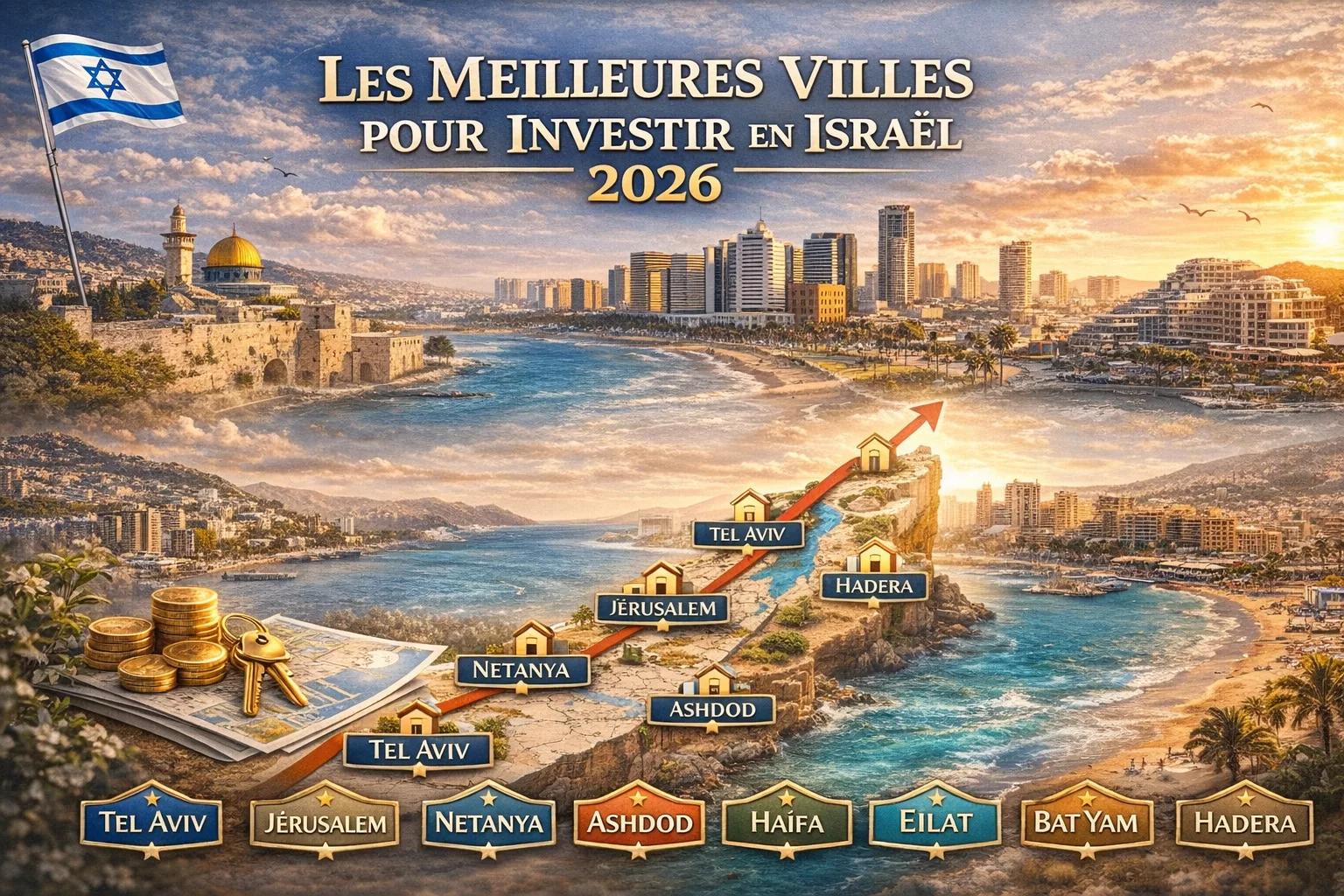
Cities to invest in Israel
The Israeli real estate market is concentrated on a relatively narrow coastal strip, but opportunities vary enormously from one city to another in terms of price, rental yield, and buyer profile.
Tel Aviv remains the most expensive and dynamic market in the country, with prices per square meter comparable to prime neighborhoods in London or Manhattan. It's the choice of international investors and buyers seeking prestige.
Jerusalem offers remarkable stability driven by constant demand, both from the diaspora and local residents. Neighborhoods vary enormously in price and atmosphere.
Netanya has become the preferred destination for French-speakers, with an established community, suitable infrastructure, and a waterfront in full renewal. Prices remain more affordable than in Tel Aviv.
Ashdod, Ashkelon, Hadera, Eilat and Bat Yam complete the landscape with each having their own profile: growing port city, seaside resort, affordable city, or economic hub.
The choice of city depends on your objective: primary residence, rental investment, pied-à-terre, or retirement preparation. Each city has its assets and limitations, and prices can double from one neighborhood to another within the same metropolitan area.
👉 Read the complete article: The best cities to invest in Israel
Explore cities on our portal →
Buying off-plan — new projects
Off-plan purchasing from a developer (kablan) is very common in Israel. New construction represents a significant portion of transactions, driven by major urban renewal projects and constant demand for housing.
The mechanism is regulated by a specific law that requires the developer to provide bank guarantees on amounts paid until delivery. The payment schedule is spread over the construction period, and 17% VAT applies (unlike existing properties where there is no VAT).
The law also protects the buyer with warranty periods on each construction item (structure, plumbing, electricity) and compensation in case of delivery delays.
⚠️ Attention: Risks exist: sometimes significant delays, differences between plans and the delivered product, and the need to properly assess the developer's financial strength. Tama 38 and Pinouyi Binouyi type projects add complexity.
👉 Read the complete article: Buying off-plan in Israel — new projects, Tama 38 and guarantees
Rental: rights, contracts and practical advice
The Israeli rental market is tight, especially in major cities. Rents are not regulated, leases are generally for one year, and local practices differ greatly from what we know in Europe or North America.
The landlord usually requires 12 post-dated checks covering the entire annual rent, plus guarantees: security deposit, personal guarantors, bank guarantee, or promissory note (shtar hov). Negotiating the rental contract is important — there is no standard contract and everything is negotiable.
The distribution of charges follows a simple principle: the tenant pays current expenses (water, electricity, arnona, vaad bait) and the owner assumes structural and condominium work. But beware, some contracts attempt to transfer more charges to the tenant.
💡 Good to know: For new immigrants, registering as a tenant with the municipality allows you to benefit from significant arnona exemptions.
👉 Read the complete article: Renting in Israel — contract, guarantees, rights and advice
Pitfalls to avoid
Twenty years of experience have shown us that the same mistakes keep coming back among buyers, whether they are beginners or experienced.
The first mistake is to proceed without a lawyer specialized in real estate. In Israel, it's the lawyer — not the notary — who secures your transaction. They verify the title deed, detect mortgages, illegal constructions, demolition orders, and negotiate each clause of the contract.
Another common pitfall: signing a document or paying a deposit before finalizing the definitive contract. Any written commitment can have immediate legal and tax consequences.
Buyers from abroad are particularly exposed: language barrier (contracts are in Hebrew), inability to visit the property regularly, and dependence on intermediaries they don't always know well.
⚠️ Don't underestimate the budget: In addition to the listed price, you must systematically add the acquisition tax, lawyer fees, agency commission, and possibly renovation work.
👉 Read the complete article: The 10 pitfalls to avoid in Israeli real estate
Real estate lexicon: essential terms
Real estate in Israel has its own vocabulary, and not mastering it can be costly. Here are the most important terms to know:
The Tabu (טאבו) is the official land registry. Registration with the Tabu is the ultimate proof of ownership. The Nesach Tabu is the cadastral extract that summarizes the legal status of the property.
The Mashkanta (משכנתא) is the mortgage loan. The Mas Rechisha (מס רכישה) is the acquisition tax. The Mas Shevach (מס שבח) is the capital gains tax.
The Vaad Bait (ועד בית) refers to the condominium committee and associated charges. The Arnona (ארנונה) is the municipal property tax. The Bodek Bait (בודק בית) is the technical property inspection expert.
The Metavekh (מתווך) is the real estate agent. The Kablan (קבלן) is the developer or builder.
👉 Read the complete article: Real estate lexicon — French, Hebrew, English
Where to start?
If you're starting your real estate project in Israel, here are the first three things to do:
1. Define your real budget including the 8-10% additional costs, and obtain pre-approval from your bank if you plan to take a loan.
2. Choose your lawyer before choosing your property. They are your primary contact, the one who will protect your interests from start to finish.
3. Explore the market on our portal to understand prices by city, neighborhood, and property type. With over 20 years of data, we have one of the most comprehensive databases of the Israeli market.
Explore listings on immobilier.co.il →
This guide is regularly updated to reflect market and Israeli legislation developments. Last update: March 2026.
immobilier.co.il — The real estate portal in Israel since 2004.